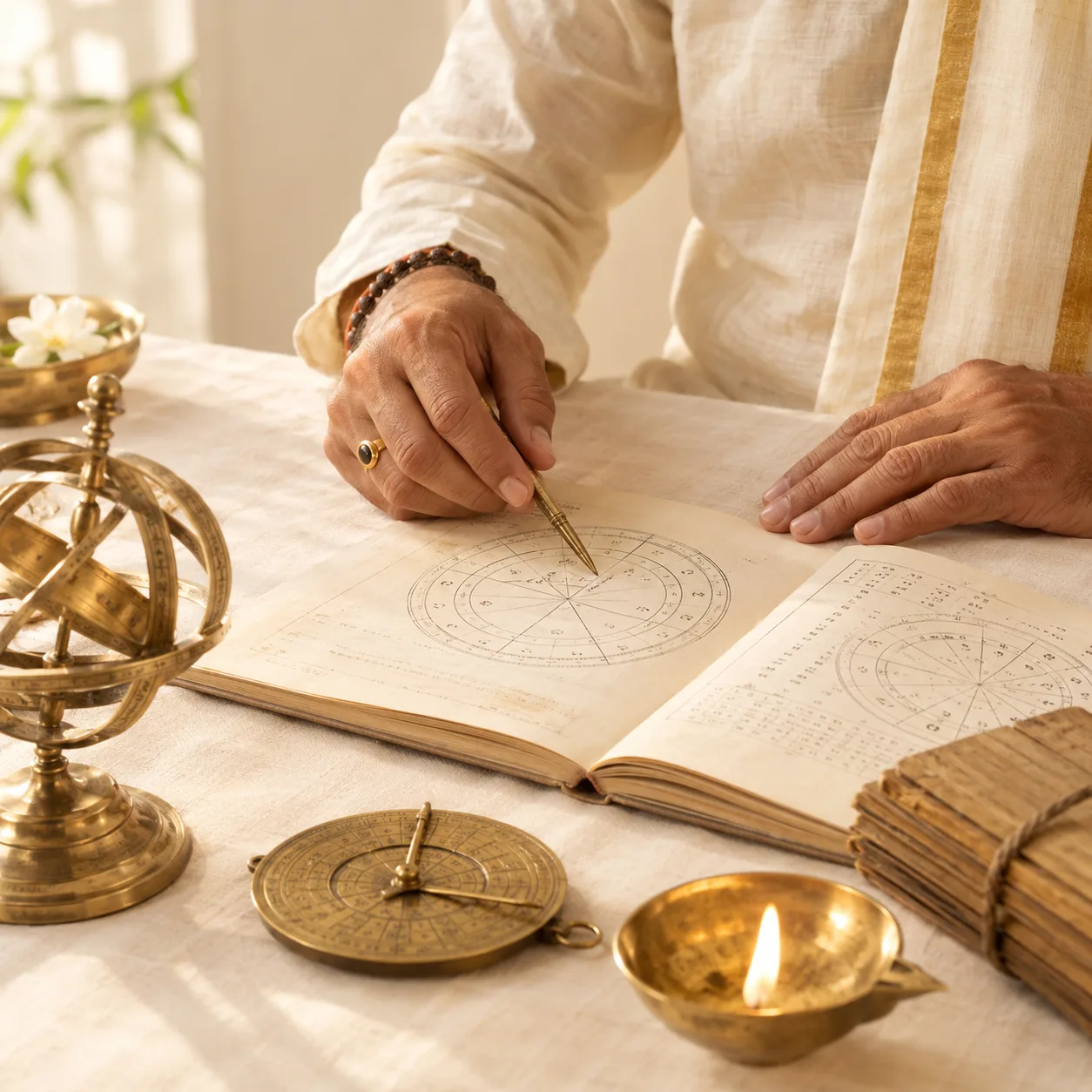
Almost every named window in the panchang is one to avoid. Rahu Kaal, Yamaganda, Gulika - all of them are times the tradition says not to begin something.
Abhijit is the exception. It is read as favourable, and it is the window most often quoted as a fallback when nothing better can be found. If you have ever been told "if you cannot find a muhurat, do it in Abhijit", this is what was meant.
The calculation
Take the daylight period - sunrise to sunset - and divide it into fifteen equal parts. Abhijit is the eighth. Being the eighth of fifteen, it sits exactly in the middle by construction, which is why it always straddles solar noon.
Each part runs roughly forty-eight minutes, though like every daylight division it stretches in summer and shrinks in winter. In Delhi it is about forty-one minutes in late December and about fifty-six in late June.
Solar noon is not twelve o'clock
This is the part that surprises people, and it is why the window differs so much between cities.
Solar noon is the moment the Sun is highest in your sky - the midpoint between your sunrise and your sunset. Clock noon is an administrative convention based on a time zone that covers an enormous area.
India runs a single time zone across roughly thirty degrees of longitude. The Sun reaches its highest point over Kolkata well before it does over Ahmedabad, but both cities read the same clock. So solar noon in the east of India falls around 11:30 am by the clock, and in the far west closer to 12:40 pm.
That means Abhijit in Kolkata and Abhijit in Mumbai can be nearly an hour apart, on the same date. A page that gives you a single national timing has given you one city's answer and called it everybody's.
This calculator uses the coordinates you enter, which is why your timing may differ from a printed almanac made for a different place. The almanac is not wrong; it is simply not yours.
The Wednesday exception, and the others
Here is what most pages leave out entirely.
Several classical sources hold that Abhijit does not apply on Wednesday. The reasoning given varies between treatments, and not every authority agrees - but it is in the literature, it is widely followed, and a page telling you Abhijit is auspicious every day without qualification has simplified the rule rather than reported it.
There are other restrictions too. The most commonly named is that Abhijit is not used for journeys to the south. Some treatments also exclude it for particular ceremonies that have their own muhurat requirements.
We flag the Wednesday case on the results page. A rule reported without its exceptions is half a rule, and on a subject where people act on the answer, the missing half matters.
Where the name comes from - the nakshatra that was dropped
This is the piece of the subject almost nobody tells you, and it is genuinely interesting.
Abhijit is also the name of a nakshatra - the twenty-eighth. The classical scheme once counted twenty-eight lunar mansions rather than twenty-seven, and Abhijit sat between Uttara Ashadha and Shravana, occupying a narrow strip near the star Vega.
It was dropped when the system settled on twenty-seven, which gave the clean arithmetic that makes the whole nakshatra scheme work: twenty-seven divides evenly into 360 degrees, giving 13°20' each, and it divides evenly by nine for the tara cycle and the navamsa. Twenty-eight does neither.
The word abhijit means unconquered or victorious. The muhurat carries the name because of that meaning and because of the nakshatra's association, and the Mahabharata itself mentions Abhijit having slipped from its place.
So the favourable window you are being offered is named after a lunar mansion that was removed from the list. That is worth knowing, and you will not find it on most pages selling you the timing.
Does Abhijit override Rahu Kaal?
Occasionally the two overlap, and people ask which wins.
The sources genuinely disagree. Some treatments hold that Abhijit, being strongly auspicious, prevails where they meet. Others hold that an overlap should simply be avoided and another time found. There is no settled answer, and anyone presenting one as settled is overstating.
What this page does is compute both and tell you whether they clash today. Then you can decide, or ask someone whose judgement you trust, rather than being handed a verdict built on one reading of a disputed point.
The honest limit
Abhijit uses no birth details. It is the same forty-eight-minute window for everyone in your city, computed from sunrise and sunset and nothing else.
That makes it a reasonable general default - a sensible time to begin something when you have nothing better to go on, and far better than picking an hour at random. It is not a muhurat chosen for your chart and your specific purpose, and the classical writers do not treat it as one.
A wedding muhurat, for instance, is selected from the nakshatra, the tithi, the weekday and the couple's own charts read together. Abhijit alone is nowhere near enough for something of that size, and a page suggesting otherwise has skipped the work.