Matching
Kundli Matching by Date of Birth — 36 Guna Milan, Every Koota Shown
Free from your birth chart — is your 36-point guna milan score, every koota with its reason, and the dosha cancellations most readings skip
Free from your birth chart — is your 36-point guna milan score, every koota with its reason, and the dosha cancellations most readings skip
Guna Milan reads both Moon charts — the birth-star, the sign and the quarter within it produce the eight tests and your total out of 36. Your own scores are in the free result above; the rule behind each one, and what it means day to day, is in the full report.
Instant premium PDF · secure payment · delivery guaranteed
Both Moon charts are read and each of the eight tests gets its own score out of 36 — with the rule that produced it printed beside it.
Manglik, Nadi and Bhakoot are checked for both of you — and every classical exception is computed on your own charts, never assumed.
Where a score came out low, you get the fix: what to do, what to avoid, and the dates when both charts support a wedding.
Your own scores are free, above. The rule behind each one, the exceptions, and the dated windows are in the full report.
Ashtakoot Guna Milan compares two Moon positions across eight separate tests and awards a maximum of 36 points: Varna 1, Vashya 2, Tara 3, Yoni 4, Graha Maitri 5, Gana 6, Bhakoot 7 and Nadi 8. Every point comes from a stated classical rule applied to the Moon’s nakshatra and rashi in each chart — not from sun-signs, and not from opinion. The commonly used threshold is 18.
That weighting is the first thing most matching reports hide. A couple scoring 24 with full Nadi and zero Varna is in a completely different position from a couple scoring 24 with zero Nadi — same total, opposite meaning. This is why every score here is printed with the rule that produced it, so you can see where your points came from and, more importantly, where they did not.
What Guna Milan genuinely measures is compatibility of instinct: how two minds react in the first ninety seconds of a crisis, whether the same sentence lands the same way in both heads, whether daily rhythm and money-flow will need negotiating, and whether closeness comes easily or has to be built. What it does not measure is love, character, loyalty, or the outcome of a marriage. No number carries that weight.
Three things sit outside the 36 points entirely and are read separately in the full report: the seventh house and its lord in both charts, the Navamsa (D9) chart which tradition treats as the deciding chart for marriage, and the Vimshottari dasha each partner is running. A 30-point match in a difficult dasha and a 20-point match with strong D9 support behave very differently in real life.
Kundli matching by date of birth reduces two charts to their Moon nakshatras and scores eight kootas — Varna 1, Vashya 2, Tara 3, Yoni 4, Graha Maitri 5, Gana 6, Bhakoot 7, Nadi 8 — for a total of 36. That is the whole method. The weights are not equal, and that is the part most pages skip: losing Varna costs 1 point, losing Nadi costs 8. A 26 with Nadi intact is a stronger match than a 30 with Nadi failed, and this kundli matching by date of birth prints every koota so you can see which one moved the total.
Gun milan score meaning is the question behind every search for “is 24 good” or “is 28 good”. The classical bands: below 18 — not recommended on the score alone; 18–24 — workable, the range most real marriages sit in; 25–32 — good to very good; 33–36 — rare, and no guarantee of an easy marriage. A score ending in .5 is not an error: Tara, Graha Maitri and Bhakoot can award half points, and this page shows where the half came from.
What no kundli matching by date of birth number can tell you is which koota is low. Two couples at 24 can be entirely different matches. Read the row, not the total.
A 36 guna milan calculator — or any kundli matching by date of birth — that prints only a total has thrown away seven-eighths of the method. This one prints each koota, the two nakshatras it was computed from, and the classical rule that gave the score — so a second astrologer can check it line by line. Where a 36 guna milan calculator elsewhere gives a different total, the difference is almost always ayanamsa, a nakshatra boundary, or a directional Vashya rule, and each of those is visible here.
Kundli matching without birth time is possible for most kootas, because they depend on the Moon's nakshatra and the Moon moves only about 13 degrees a day. Where kundli matching by date of birth fails is the boundary: if either Moon sits within a degree of a nakshatra edge, the pada — and with it Nadi and Bhakoot — can flip. This kundli matching without birth time flags exactly that case instead of guessing, and tells you which koota is uncertain.
Nadi dosha is the same Nadi for both — Adya, Madhya or Antya — and it costs all 8 points. What the texts also say, and what almost no nadi dosha cancellation check prints: it is cancelled when the two Moon signs are the same but the nakshatras differ; when the nakshatras are the same but the padas differ; when the Moon signs are ruled by the same planet; when Bhakoot is clean and Rashi lords are friends; and in several regional readings when the couple's Nadi lords are mutual friends. This kundli matching by date of birth tests each nadi dosha cancellation rule against your two charts and prints which one, if any, applies.
Rajju dosha is a nakshatra-group test from the Dashakoot system of South India, and it is treated there as the single most serious porutham — more than Nadi. The 27 nakshatras fall into five rajju groups (foot, thigh, navel, neck, head); the same group for both is read as the dosha, with the neck and head groups weighted heaviest. Rajju dosha does not appear in northern kundli matching by date of birth at all, which is why a match that scores 30 in the North can be refused in the South. This page prints it.
Can I marry if kundli does not match is asked by people who already know the answer they want. The honest one, from any kundli matching by date of birth: a low score is a checklist, not a verdict. The texts give cancellations for every major dosha, and the traditions that take matching most seriously also allow a marriage to proceed on a strong 7th house, a compatible Navamsa and a supportive dasha. If someone has told you the match is impossible on the score alone, ask which cancellations they checked. This page checks them.
Kundli matching for love marriage runs the same kundli matching by date of birth, but the question changes. In an arranged match, the score decides whether to proceed. In a love match, the decision is made; the score tells you where effort will be needed. A low Gana koota in a love marriage means you already know the temperaments clash — the chart is confirming what you have lived. Kundli matching for love marriage is most useful read that way: as a map of the friction, not a permission slip.

All eight are counted, but they do not matter equally in practice.
Nadi (8) is the heaviest single objection when it fails - and it has the clearest set of exceptions. Bhakoot (7) governs emotional and financial flow. Graha Maitri (5) is the one people actually feel day to day, because it describes how the two minds get along.
Yoni (4) is the most over-read koota in the whole system; it describes instinct, not character. Varna (1) is the mildest of all - a zero there is not a reason to reject anything.
Two matches with the same total can therefore read very differently. This report shows the split, not only the number.

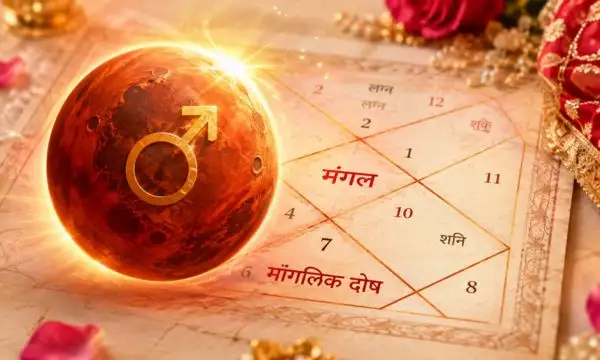
Mangal dosha means Mars sits in the 1st, 2nd, 4th, 7th, 8th or 12th house from the ascendant, Moon or Venus, depending on the tradition followed.
It does not mean widowhood, violence or certain divorce. That reading is a modern exaggeration and it has frightened a great many families for no good reason.
Recognised cancellations include: both partners carrying it, Mars in its own sign or exalted, Mars aspected by or with Jupiter, and in several traditions age above 28. Which houses count also differs between traditions - two competent astrologers can honestly disagree on the same chart.
Guna Milan cannot predict divorce, an affair, or the length of a marriage. It cannot measure respect, honesty, money sense or the willingness to apologise first - and those decide far more marriages than any koota.
A 30-point match between two people who have never discussed money is weaker than an 18-point match between two who have. Any report that tells you otherwise is selling certainty it does not have.
Every one of the eight kootas is read from the Moon — its rashi, its nakshatra, and the pada within that nakshatra. This is why birth time matters so much: the Moon moves about thirteen degrees a day, so an hour’s error can change the nakshatra, and with it Tara, Yoni, Gana and Nadi at once. Our report stress-tests every conclusion at plus and minus five minutes and states which findings hold and which move.
Nadi, Bhakoot and Manglik frighten more couples than the rest of astrology combined — and all three carry classical cancellations that are almost never reported. Same Moon-sign with different stars cancels Nadi. Friendly sign-lords cancel Bhakoot. Own-sign or exalted Mars, Jupiter’s aspect, and both partners being Manglik all soften Manglik dosha. We compute every one of these on your two charts and print the residual concern in a single honest line.
Both charts run their own Vimshottari periods, and those periods rarely align by chance. A wedding under a supportive Venus or Jupiter sub-period in both charts behaves very differently from one held during a testing stretch. Your free result computes the windows where both charts run a marriage-supportive sub-period at the same time, with real dates — the season, not the hour. The exact muhurta still needs a Panchang and both charts together.
Swiss Ephemeris + Lahiri ayanamsa — the same standard as traditional panchangs. Both Moons computed from real birth details and real coordinates, never guessed from a name.
Every score prints the classical rule that produced it, right beside the number. Any astrologer can check our working line by line.
A dosha is a signal to check, never a verdict on two people. We compute the classical exceptions on your own charts and state every remedy with its honest limit.
The Hindi report is written natively — not machine-translated. English and Hindi carry the same 153-page depth, chapter for chapter.
Date, time and place — the Moon sign is the anchor, and time makes it certain.
Swiss Ephemeris (Lahiri sidereal) reads both Moon nakshatras and scores all eight kootas out of 36
See your score, score and dosha check free; unlock the verdict, life-area guidance and remedies.
 🔒Both Charts
 🔒Eight Tests
 🔒Dosha Checks
 🔒Family & Money
 🔒Verdict & Plan
 🔒Remedies
Both charts, koota by koota, with every dosha and its cancellation stated plainly.
Every date computed from your own chart — nothing generic, nothing guessed.

| What you get | Free | Full Report |
|---|---|---|
| Your total out of 36 | ✓ | ✓ |
| All eight tests with individual scores | ✓ | ✓ |
| The rule behind every score, written out | ✓ | ✓ |
| Both charts: Moon, birth-star, pada, ascendant | ✓ | ✓ |
| Gana, Yoni, Nadi and Varna for both of you | ✓ | ✓ |
| Nadi, Bhakoot and Manglik status | ✓ | ✓ |
| Both birth-stars and what they mean | ✓ | ✓ |
| Favourable windows with real dates | ✓ | ✓ |
| Four charts drawn - birth charts and marriage charts | ✗ | ✓ |
| Every dosha exception computed on your own charts | ✗ | ✓ |
| The marriage house in depth, for each of you | ✗ | ✓ |
| Twelve planet meetings, each pair scored | ✗ | ✓ |
| Every finding re-checked in the Navamsa chart | ✗ | ✓ |
| Your argument pattern and six steps to stop it | ✗ | ✓ |
| How to divide the housework, money and saving | ✗ | ✓ |
| Career, family and traditional child indications | ✗ | ✓ |
| Five-year outlook and twelve-month planner | ✗ | ✓ |
| A 30-day action plan | ✗ | ✓ |
| A hundred conversation questions, plus twelve for before the wedding | ✗ | ✓ |
| Remedies with their honest limits | ✗ | ✓ |
| A plain-English glossary of every term used | ✗ | ✓ |
| The final verdict - what works and what needs work | ✗ | ✓ |
| 153 page PDF in English and Hindi | ✗ | ✓ |
These are the traditional koota rules. YOUR version — tuned to which kootas actually scored low in your two charts — fills the conflict map and the 30-day plan in the full report.
Instant PDF · from ₹99 · the same engine you just used free

Be the first to review this reading.

Every AstroMool reading is generated from your exact birth chart using the Swiss Ephemeris and classical Parashari & Jaimini principles, then reviewed for accuracy — no generic templates, no guesswork. Last updated: September 2026
Page generated: 20 Sep 2026, 09:34 IST · build cp-2609200934