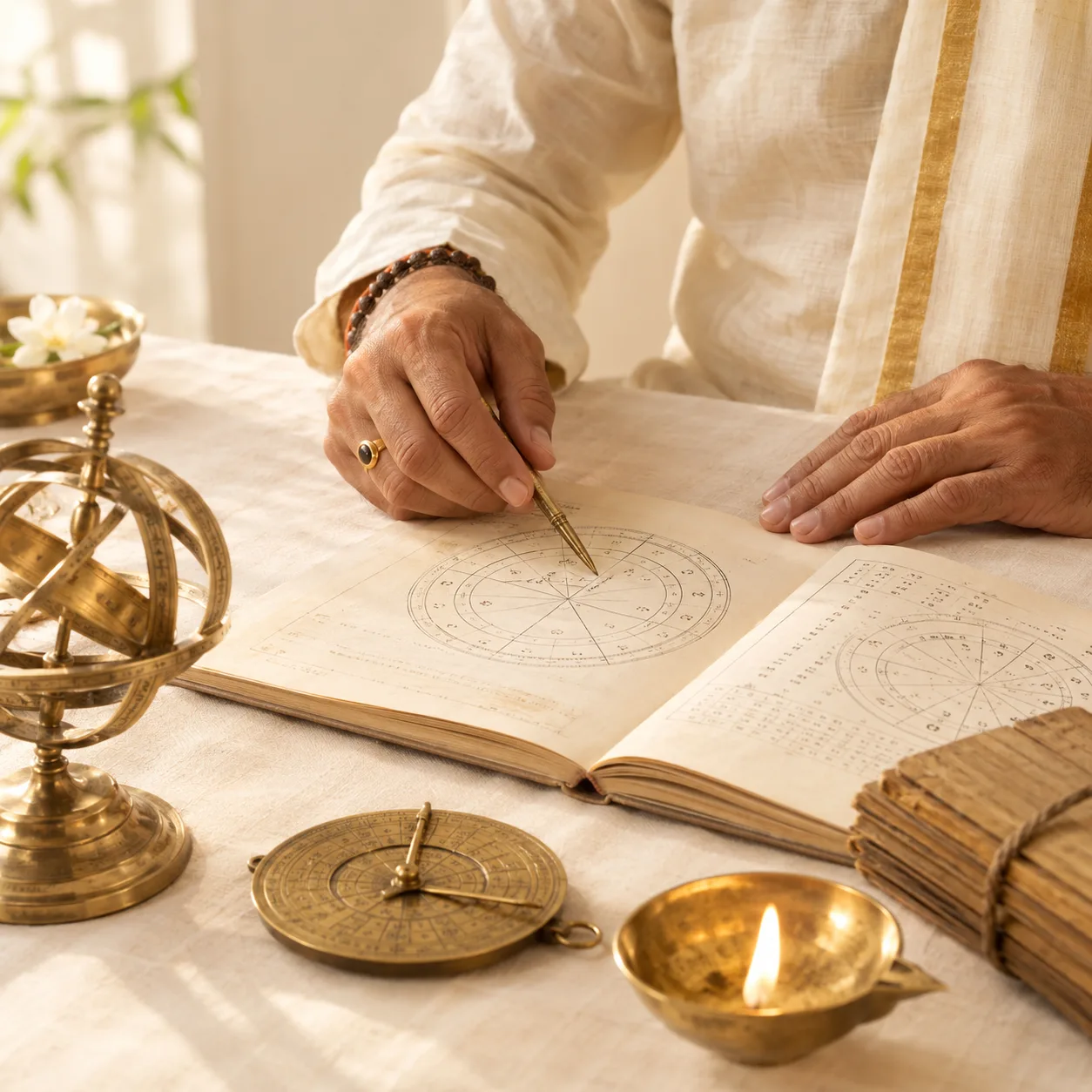
The ninefold division computed for your chart - each planet's navamsa sign, your D9 ascendant, and the placements that repeat from the birth chart. With the counting rule, so any row can be checked on paper.
Guna Milan reads both Sun charts — the birth-star, the sign and the quarter within it produce the eight tests and your total out of 36. Your own scores are in the free result above; the rule behind each one, and what it means day to day, is in the full report.
Instant premium PDF · secure payment · delivery guaranteed
Both Sun charts are read and each of the eight tests gets its own score out of 36 — with the rule that produced it printed beside it.
Manglik, Nadi and Bhakoot are checked for both of you — and every classical exception is computed on your own charts, never assumed.
Where a score came out low, you get the fix: what to do, what to avoid, and the dates when your chart support a wedding.
Your own scores are free, above. The rule behind each one, the exceptions, and the dated windows are in the full report.
The navamsa is the ninefold division. Each of the twelve signs splits into nine parts of 3°20' each - 108 divisions across the zodiac - and each part maps to a sign of the D9 chart. Your navamsa chart is what you get when every planet is placed by the part it falls in rather than by the sign it sits in.
It is the most used divisional chart in the entire system. In practice, an astrologer who looks at one chart looks at the birth chart; an astrologer who looks at two looks at the birth chart and the navamsa.
The nine divisions of a sign start from a different place depending on the sign's element:
From that starting sign, count forward one sign per 3°20' division.
An example. A planet at 12° of Taurus: Taurus is an earth sign, so start at Capricorn. Twelve degrees divided by 3°20' gives division four (0 to 3°20' is the first, 3°20' to 6°40' the second, and so on - 12° falls in the fourth). Count four from Capricorn: Capricorn, Aquarius, Pisces, Aries. So that planet's navamsa is Aries.
That is the whole calculation. Every row on this page can be reproduced with that rule and a planet's degree - which is the point of printing it rather than just handing you a chart.
The classical position is often put this way: the birth chart shows what is promised, and the navamsa shows whether it holds.
A planet strong in the D1 and weak in the D9 is read as a promise that thins out - looks good on the surface, less substantial underneath. A planet weak in the D1 and strong in the D9 is the reverse: something that holds better than it first appeared.
That comparison is the point of the chart. Reading a D9 on its own, without the birth chart beside it, misses what it is for.
A planet in the same sign in both the birth chart and the navamsa is called vargottama - literally "best of the divisions".
The tradition reads it as strengthened: the promise and the inner level agreeing, the outer and the deeper saying the same thing. It is one of the clearest strength indications in the whole system, and it requires no interpretation - either the two signs match or they do not.
Most free D9 charts do not mark it, which means the single most useful thing the chart can show you goes unmentioned. We mark it.
A note on how it happens: vargottama occurs when a planet sits in the first navamsa of a movable sign, the fifth of a fixed sign, or the ninth of a dual sign. That is why it is not evenly distributed and why some charts have several and others none.
The navamsa is read as a chart in its own right - with its own ascendant and its own twelve houses. A D9 that lists planets without computing the D9 lagna has given you positions without a frame to read them in.
But here is the catch. A navamsa spans 3°20', and the ascendant moves through the zodiac in twenty-four hours. So the D9 ascendant changes roughly every thirteen minutes.
That makes the D9 lagna more birth-time-sensitive than almost anything else you will compute. A birth time out by half an hour gives you a different D9 ascendant, and a chart read from it is reading the wrong houses.
This page tells you how much margin you have, rather than presenting a D9 lagna as solid when your birth time came from a family estimate.
The D9 is introduced almost everywhere as "the marriage chart", and that is worth pushing back on.
It is the ninth division. The classical writers use it for the durability of things generally - whether what the birth chart promises actually holds. Marriage is one prominent application, partly because the 9th and 7th have a classical relationship and partly because marriage is a subject where durability is exactly the question.
But reading your spouse's character out of a D9 goes well past what the division supports. The navamsa does not contain a person; it contains your own planets placed one level finer. A page that describes your future partner from your D9 has left the method behind some way back.
Sixteen divisional charts - the shodashavarga - are in common classical use, each read for a different subject:
The D9 is the most used of all of them, and after the birth chart itself it is the one most astrologers actually look at. The D7 is the one almost nothing online computes - our Santan Yog calculator does.
The ayanamsha first - a sidereal chart and a tropical one differ by about twenty-four degrees, which changes navamsas wholesale.
Then the birth time, and here the D9 is unusually exposed. A few minutes moves the D9 ascendant; a few more can move a fast planet like the Moon into a different navamsa. Small differences that would not show up in a birth chart show up here.
We use Lahiri and your own coordinates, and we print the degree each navamsa was computed from, so a borderline case is visible rather than hidden.

Every planet's navamsa sign with the division it fell in, plus the D9 ascendant - and the rule that produced each row, so nothing has to be taken on trust.
Which of the planets sit in the same sign in both charts, why that happens where it does, and what the classical writers read into it.
The two charts side by side, so you can see which placements held across the division and which changed - which is the comparison the D9 exists for.
How the D9 ascendant moves, how much your birth time can shift before it changes sign, and what to do if your time is a family estimate rather than a record.
Fire from Aries, earth from Capricorn, air from Libra, water from Cancer - with a worked example so you can reproduce any row on paper.
Durability rather than a portrait of a spouse. What the classical writers use it for, and where the popular framing has gone further than the division supports.
Where the D9 sits among the shodashavarga - D2 for wealth, D3 for siblings, D7 for children, D10 for career - and why the D9 is the one everyone actually uses.
Swiss Ephemeris + Lahiri ayanamsa — the same standard as traditional panchangs. Both Suns computed from real birth details and real coordinates, never guessed from a name.
Every score prints the classical rule that produced it, right beside the number. Any astrologer can check our working line by line.
A dosha is a signal to check, never a verdict on two people. We compute the classical exceptions on your own charts and state every remedy with its honest limit.
The Hindi report is written natively — not machine-translated. English and Hindi carry the same free depth, chapter for chapter.
Date, time and place — the Sun sign is the anchor, and time makes it certain.
Swiss Ephemeris (Lahiri sidereal) tracks the Sun through the 12th, 1st and 2nd signs from your Sun — day-level, your chart checked together.
See your score, timeline and end date free; unlock the verdict, life-area guidance and remedies.
This navamsa calculator by date of birth answers the six questions people search most — d9 chart calculator free, how to read navamsa chart, navamsa chart for marriage prediction, vargottama planets calculator, navamsa kundli kaise dekhe — each with the rule behind it. The navamsa calculator by date of birth above computes your own result free; the sections below explain what it means, and a navamsa calculator by date of birth that shows its working is one you can check against any astrologer.
A navamsa calculator by date of birth divides each sign of the birth chart into nine parts of 3 degrees 20 minutes and places every planet in a new sign by which ninth it fell in. The result is the D9 chart — the one the texts read for marriage, the partner, and the true strength of every planet. This navamsa calculator by date of birth prints the D9 lagna, each planet's navamsa sign and house, and marks the vargottama planets, from the same ephemeris positions as the birth chart.
A d9 chart calculator free of errors must have a precise time, because a navamsa is only 3 degrees 20 minutes wide: the navamsa lagna changes about every 13 minutes, six times faster than the birth lagna. A birth time that is ten minutes off can move the D9 lagna a sign. This d9 chart calculator free tool prints the navamsa lagna's degree so you can see how close it sits to a boundary, and it says plainly when the D9 lagna cannot be trusted on a rounded time.
How to read navamsa chart is a question with a method: first the navamsa lagna and its lord (the inner self and the marriage), then the planets that are vargottama (same sign in D1 and D9 — strong and reliable), then each planet's navamsa dignity (a planet exalted in D1 but debilitated in D9 promises more than it delivers), and last the navamsa 7th house and Venus for marriage. How to read navamsa chart in that order avoids the commonest error, which is reading the D9 as a second birth chart.
Navamsa chart for marriage prediction reads three things: the navamsa 7th house and its lord for the partner's nature, Venus in the navamsa (and Jupiter in a woman's chart) for the quality of the bond, and the navamsa lagna lord's placement for how the native holds a marriage. A strong D1 7th with a weak D9 7th is read as attraction that struggles after the wedding. Navamsa chart for marriage prediction here prints those three with their dignities, and links to the full marriage report for timing.
A vargottama planets calculator marks the planets that fall in the same sign in the birth chart and the navamsa. The texts treat a vargottama planet as nearly as strong as one in its own sign, whatever its D1 dignity: it delivers what it promises. A vargottama lagna is read the same way for the native. This vargottama planets calculator lists them in your chart, and the reverse case too — planets that lose dignity in the D9 — because those are the promises to be careful of.
Navamsa kundli kaise dekhe is answered on this page with the chart drawn and the rules beside it: the D9 lagna, the nine houses counted from it, each planet's sign, and the vargottama marks. Navamsa kundli kaise dekhe for marriage means the 7th from the D9 lagna and Venus; for strength it means each planet's D9 dignity against its D1 dignity. Both readings are printed, and the birth time's precision is stated so the D9 lagna is trusted only when it should be.
If you came to this navamsa calculator by date of birth to check a result from another app, compare the degree, not just the sign — two tools using different ayanamsas will disagree by about a sign near boundaries. This navamsa calculator by date of birth prints Lahiri, the value used, and every intermediate step, so the navamsa calculator by date of birth result can be verified line by line.
Be the first to review this reading.
Page generated: 23 Sep 2026, 11:07 IST · build cp-2609231107