Dasha & Timing
Manglik Dosha Calculator by Date of Birth — Are You Manglik?
Free from your birth chart — the mukhi, the planet it supports, and the beads you can safely skip.
Free from your birth chart — the mukhi, the planet it supports, and the beads you can safely skip.
The highlighted section at the top is your 1st house — the house of the body and vitality. Its lord decides your main bead. Your complete chart, with all nine planets scored for bead-worthiness, is in the full report.
Instant premium PDF · secure payment · delivery guaranteed
Every reckoning checked, every cancellation applied, every figure computed from your own birth details.
Every bead reasoned from your own chart — nothing generic, nothing guessed.
| What you get | Free | Full Report |
|---|---|---|
| Whether Mars falls in a Manglik house from your ascendant | ✓ | ✓ |
| Your Mars: sign, house and dignity | ✓ | ✓ |
| Manglik intensity score | ✓ | ✓ |
| Whether a cancellation applies | ✓ | ✓ |
| Mars checked from the Moon and from Venus | ✗ | ✓ |
| Every classical cancellation, one by one, with reasons | ✗ | ✓ |
| What it means for marriage - the honest version | ✗ | ✓ |
| Matching with Manglik and non-Manglik partners | ✗ | ✓ |
| Supportive marriage periods with real dates | ✗ | ✓ |
| Mars in your specific house, explained in full | ✗ | ✓ |
| All nine planets and twelve houses with dignity | ✗ | ✓ |
| Remedies with honest limits | ✗ | ✓ |
| 45-question FAQ answered from your chart | ✗ | ✓ |
| Glossary and an honest limits page | ✗ | ✓ |
| 122-page PDF in English and Hindi, yours to keep | ✗ | ✓ |






Be the first to review this reading.
A manglik dosha calculator by date of birth does one thing: it finds where Mars sits in your chart and tests that position against a fixed list of houses. That is the whole method, and it is worth saying plainly, because most pages wrap it in enough dread to sell a puja at the end.
The houses are the 1st, 2nd, 4th, 7th, 8th and 12th. Mars in any of these, counted from the ascendant, is the classical definition. This manglik dosha calculator by date of birth also counts from the Moon and from Venus, because the texts do, and prints all three so you can see which reference gave which result.
Here is the number that changes how you read everything else: six houses out of twelve qualify. Before any cancellation is applied, roughly one person in every two is manglik by the strict rule. After cancellations it settles near one in four. That is not a curse. That is a quarter of everyone you know.
Am I manglik — the question every manglik dosha calculator by date of birth is asked — has three answers, not one, because the tradition counts Mars from three points. From the lagna is the primary test and the one most calculators stop at. From the Moon is the second, and many South Indian traditions weigh it equally. From Venus is the third, because Venus is the significator of marriage.
A chart can be manglik from one reference and clean from the other two. That is the most common result, and it is why this page prints three verdicts rather than collapsing them into a single word. A page that says only yes or no has thrown away two-thirds of the method.
The texts that define mangal dosha, and that every honest manglik dosha calculator by date of birth relies on, also define mangal dosha cancellation, in the same chapters, by the same authors. These are not modern softenings. Mars in its own sign or exalted, Mars in Leo or Aquarius, Mars aspected by Jupiter, both partners manglik, Mars in the 2nd in Gemini or Virgo, Mars in the 12th in Taurus or Libra — the list runs to more than a dozen conditions, and this calculator checks every one it can from your chart.
We print these because a page that names the dosha and hides the cancellation has used half the method. If someone has told you that you are manglik and stopped there, the first question to ask is which cancellations they checked.
Manglik dosh kya hai — and why a manglik dosha calculator by date of birth cannot answer it with one word: it is a placement, not a curse. Mars is the planet of drive, heat and argument. In the houses that govern self, family, home, partnership, longevity and loss, the tradition reads that heat as something that needs a matching temperament on the other side — which is why the classical remedy is not a ritual but a partner who is also manglik.
What manglik dosh does not mean: that marriage will fail, that a spouse will die, that you must marry a tree. Those claims appear in no classical text. They appear on pages that have something to sell after the fear.
Kuja dosha calculator is the same manglik dosha calculator by date of birth under its Tamil and Telugu name, and the southern tradition adds two things worth knowing. It counts the 2nd house more consistently than the North does, and it gives the Moon reference equal weight with the lagna. So a chart called clean by a northern reading can be called kuja-afflicted by a southern one — and neither is wrong. They are different conventions, and this calculator shows both.
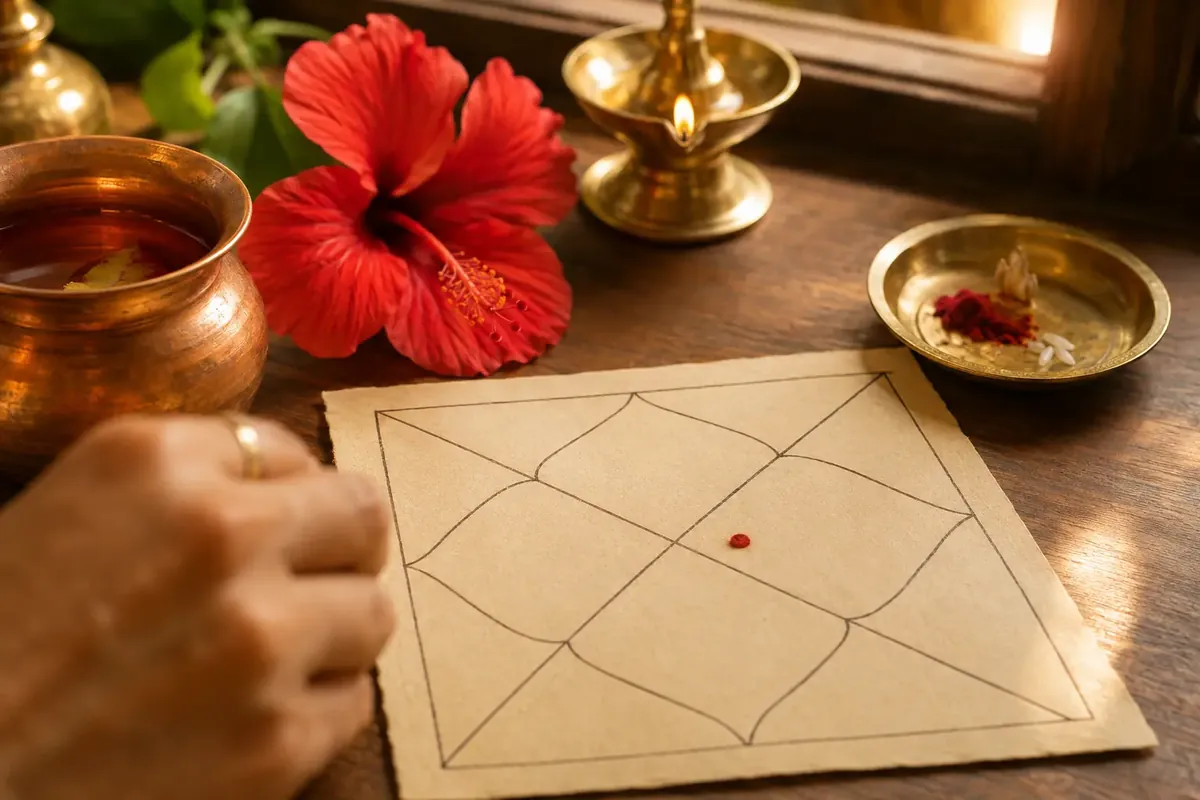
Three reckonings, in this order.
1. From the ascendant. The standard method: Mars in the 1st, 2nd, 4th, 7th, 8th or 12th house counts. This is the one nearly everyone uses, and often the only one.
2. From the Moon. Count the same houses from your Moon sign instead. Many charts that look Manglik from the ascendant are clear from the Moon, and the tradition treats that as a meaningful reduction.
3. From Venus. Venus governs marriage, so southern practice checks Mars from Venus as well. This is the reckoning most often skipped.
Your report shows all three, states which houses Mars occupies in each, and gives you the combined picture rather than a single scary word.

Classical texts list many conditions under which Manglik dosha does not operate. The common ones:
• Mars in its own sign (Aries or Scorpio) or exalted in Capricorn.
• Mars aspected by or conjunct Jupiter.
• Mars in the 7th house in Cancer or Capricorn.
• Both partners Manglik - the dosha is considered to cancel.
• Mars in a friendly sign, or in the sign of a benefic.
• Marriage after 28, in several traditions.
• Saturn aspecting Mars, in some schools.
Your report checks each of these against your own chart and lists which ones apply, with the chart fact behind each. A cancellation is not a loophole - it is part of the same tradition that defines the dosha in the first place.

Two people can both be Manglik and be in completely different situations.
Mild: Mars in the 2nd or 12th, in a friendly sign, with a Jupiter aspect. Traditionally this barely registers.
Moderate: Mars in the 4th or 8th, neutral dignity, no cancellation.
Strong: Mars in the 7th, debilitated or in an enemy sign, with no cancellation and no benefic aspect.
Your report scores this from 0 to 100 and shows the arithmetic. A score of 20 and a score of 80 should not be discussed in the same breath - and no honest report treats them the same way.

What the tradition actually says: Mars in these houses is associated with impatience, sharper words during conflict, and a tendency to escalate rather than settle. That is a temperament description, and it is worth knowing.
What it does not say: it does not predict the death of a spouse, guarantee divorce, or make anyone unmarriageable. Those claims are recent additions and they have caused real harm to real families.
If you have been told you cannot marry a particular person because of this, ask for the chart facts. Which reckoning? Which house? Which cancellations were checked? If you do not get those answers, you are being sold a fear rather than a reading.

Manglik status is one factor, not the whole question. When both charts are available, the tradition looks at whether the dosha is mutual, whether either side has a cancellation, and what the wider compatibility says.
A pairing where both are Manglik is traditionally considered fine. A pairing where one is Manglik with a cancellation and the other is not is also usually considered workable. The cases worth discussing carefully are strong, uncancelled dosha on one side only.
Even then, the correct response is a conversation - not a rejection. Your report says exactly this, in plain words you can show to a family member.
Date, exact time and place — the 1st house needs an accurate time.
Swiss Ephemeris computes your ascendant and its lord, your Moon sign lord and the dignity of all nine planets.
See your free snapshot; unlock ranked fields, dated timing, income band and remedies.

Every AstroMool reading is generated from your exact birth chart using the Swiss Ephemeris and classical Parashari & Jaimini principles, then reviewed for accuracy — no generic templates, no guesswork. Last updated: September 2026
Find where Mars sits in your birth chart, counted from the ascendant. If it is in the 1st, 2nd, 4th, 7th, 8th or 12th house, the strict rule calls the chart manglik. Then check the same from the Moon and from Venus, and then check the cancellations - because most charts that pass the first test fail the second. This calculator prints all of it.
Double manglik means Mars qualifies from two of the three references - lagna, Moon, Venus - at once. Triple manglik means all three. The texts do not use these terms; they are a modern shorthand for how many references agree. A double manglik chart with a strong cancellation can still be read as clean.
Anshik means partial. It is used when Mars is in a qualifying house from one reference only, or when a cancellation applies but is not total. It is a working label, not a classical category. What matters is which reference and which cancellation - and this page names both.
The tradition prefers manglik to manglik, on the reasoning that two similar temperaments balance. But the same texts list the cancellations that make a manglik chart effectively clean, and a chart with a valid cancellation is read as non-manglik for matching. So the honest answer is: check the cancellations first, then match. Most of the fear around this question comes from skipping that step.
The texts give conduct: Tuesday fasting, Hanuman Chalisa, red lentil donation, respect for siblings and for those who serve. None has a price. Kumbh vivah - the symbolic marriage to a tree or an idol - appears in later tradition, not in the classical texts, and its cost is entirely the priest's. We will not tell you that you need it.
No classical text says a puja is necessary. The texts say the dosha is cancelled by the placements listed above, or balanced by a manglik partner. A page that says your marriage cannot proceed without a nivaran puja is describing its own income, not the shastra.
A widely quoted claim says the dosha loses force after 28. No classical text states it; it appears in oral tradition and on websites. What the texts do say is that Mars matures at 28, which is a different claim. Treat the 28 rule as a comfort, not a calculation.
From the ascendant reckoning, yes - the 7th is one of the six Manglik houses. But that is only the first of three checks. Mars must also be checked from your Moon and from Venus, and any classical cancellation has to be applied before the answer means anything. This calculator does all three.
The 1st, 2nd, 4th, 7th, 8th and 12th. Some traditions leave out the 2nd; southern practice includes it. Your report shows which houses Mars occupies in each reckoning so you can see exactly where the answer comes from.
Mars in its own sign or exalted, Mars aspected by or with Jupiter, Mars in the 7th in Cancer or Capricorn, both partners being Manglik, Mars in a friendly sign, and marriage after 28 in several traditions. Your report checks each one against your chart and states which apply.
Yes. The tradition suggests checking whether a cancellation applies, and looking at the wider compatibility rather than this one factor. A strong uncancelled dosha on one side alone is the case worth discussing carefully - and even then the correct response is a conversation, not a rejection.
No. Classical texts associate Mars in these houses with impatience and sharper conflict, which is a temperament description. Claims about widowhood or guaranteed divorce are later additions, and they have caused real harm. This report says so plainly.
It is a real part of the Vedic tradition, with a defined method and defined exceptions. Whether it predicts outcomes is not something astrology can prove, and this report does not pretend otherwise. What it can do is tell you accurately what your chart says by that method.
Several traditions hold that its effect reduces after 28. That is a traditional position, not a measurement, and your report labels it as such rather than presenting it as fact.
Only if you want to. These are traditional practices, not requirements. Your report explains what each involves and states clearly that no ritual is mandatory - and that anyone insisting otherwise while charging you for it is selling, not advising.
Almost always because they used different reckonings, or one applied cancellations and the other did not. Your report shows all three reckonings and every cancellation, so you can see exactly where any disagreement comes from.
Yes. Kuja is the southern name for Mars, so Kuja dosha, Mangal dosha and Manglik dosha all describe the same thing, though southern practice checks Venus more consistently.
The tradition connects it mainly to marriage and partnership. Mars in these houses is also read for temperament and conflict style, which your report covers - but the outcome claims stop there.
It is not written for that. It gives you the chart facts and the honest tradition so you can have an informed conversation. If someone wants a report to justify a rejection, this is not that report.
Page generated: 20 Sep 2026, 09:39 IST · build cp-2609200939