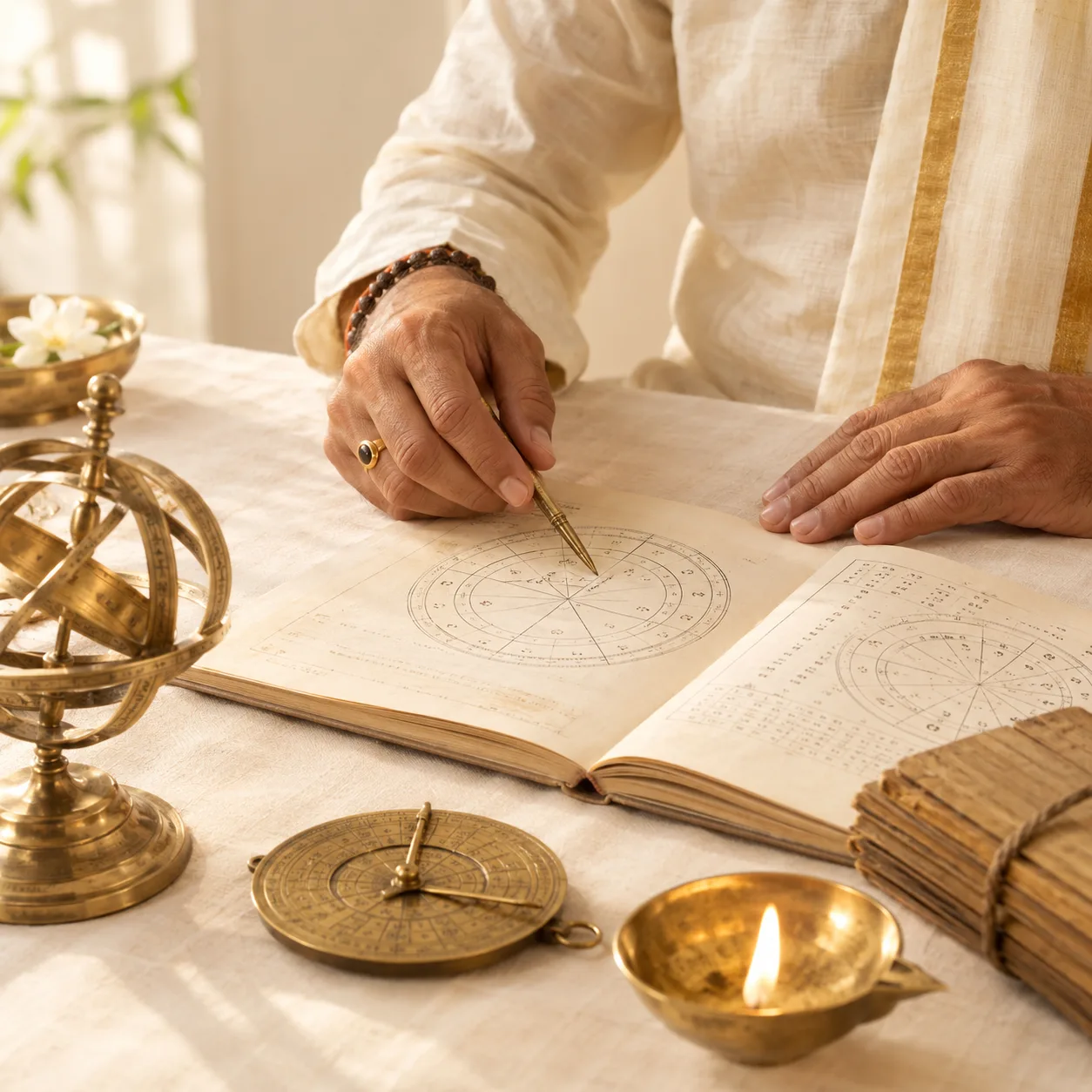
Your mahadasha and the antardasha inside it, dated, with all nine sub-periods of the period you are in. Plus the proportion rule - mahadasha years times sub-planet years over 120 - so nothing has to be taken on trust.
Guna Milan reads both Sun charts — the birth-star, the sign and the quarter within it produce the eight tests and your total out of 36. Your own scores are in the free result above; the rule behind each one, and what it means day to day, is in the full report.
Instant premium PDF · secure payment · delivery guaranteed
Both Sun charts are read and each of the eight tests gets its own score out of 36 — with the rule that produced it printed beside it.
Manglik, Nadi and Bhakoot are checked for both of you — and every classical exception is computed on your own charts, never assumed.
Where a score came out low, you get the fix: what to do, what to avoid, and the dates when your chart support a wedding.
Your own scores are free, above. The rule behind each one, the exceptions, and the dated windows are in the full report.
The Vimshottari system divides a life into nine mahadashas - planetary periods running in a fixed order and totalling exactly a hundred and twenty years:
Ketu 7, Venus 20, Sun 6, Moon 10, Mars 7, Rahu 18, Jupiter 16, Saturn 19, Mercury 17.
Those nine numbers never change. They are the same for every chart ever cast, in the same order. The only thing your chart decides is where in the cycle you start - and that comes from your Moon's nakshatra.
A mahadasha of nineteen years is not one undifferentiated stretch. Each one divides into nine antardashas (also called bhuktis), running in the same fixed order and in proportion to their own lengths.
So Saturn's nineteen years contain a Saturn-Saturn of about three years, then Saturn-Mercury, Saturn-Ketu, Saturn-Venus, and so on through all nine, always starting with the mahadasha lord itself.
The proportion rule, printed: an antardasha lasts the mahadasha length, multiplied by the sub-planet's years, divided by 120.
Saturn-Mercury is 19 × 17 ÷ 120 = 2.69 years. Jupiter-Venus is 16 × 20 ÷ 120 = 2.67 years. Ketu-Sun is 7 × 6 ÷ 120 = 0.35 years, about four months.
That is the whole calculation. Anyone can reproduce any of the eighty-one combinations with a calculator, which is exactly why we print the rule rather than only the dates.
The nakshatra your Moon occupied at birth decides everything here.
Its lord rules your first mahadasha. Ashwini, Magha and Mula belong to Ketu, so anyone born in those starts in a Ketu period. Bharani, Purva Phalguni and Purva Ashadha belong to Venus, and start with twenty years of Venus.
And how far into the nakshatra the Moon sat decides how much of that first period had already run before you were born. A Moon at 40% through its nakshatra means 40% of the first mahadasha was already spent - which is why almost nobody starts life at the beginning of a period.
That balance is the figure everything after it rests on. Get it wrong by a year and every date in your chart moves by a year.
The division does not end at two levels. Each antardasha divides again into nine pratyantardashas, by the same proportion rule. Those divide into sookshma periods, and those into prana.
Five levels in all, and the classical writers do describe them. But the arithmetic runs away quickly: a prana dasha in a short period can be a matter of hours, and the accumulated sensitivity to your birth time becomes larger than the period itself.
Most practitioners work with two levels routinely, three when a question needs it, and treat four and five as theoretical. That is a reasonable place to stop, and it is worth knowing that the deeper levels exist without being impressed by someone quoting them at you.
A period is not a forecast.
The classical writers read a dasha as bringing the affairs of that planet forward - what it rules in your chart, what it signifies naturally, where it sits and in what condition. A Jupiter period brings Jupiter's subjects into view. A Saturn period brings Saturn's.
They do not produce events from it. No classical source turns a dasha into a dated prediction, and a page telling you what will happen in your Rahu period has gone well past the method it claims to be using.
What a dasha is genuinely useful for is reading a finding against time. A placement in your chart is permanent - it was there at birth and it will be there at the end. Whether the tradition reads it as currently active depends on whose period is running. That is the whole value of knowing this, and it is a real value.
Neither, by itself, and this is worth being clear about because planets carry reputations.
Saturn is not a bad period and Jupiter is not a good one. A period brings that planet's affairs forward - and whether that is welcome depends entirely on what that planet does in your particular chart. Saturn ruling your 10th and well placed is a different thing from Saturn ruling your 6th and afflicted, and both are Saturn periods.
The reputation of the planet tells you almost nothing. Its role in your chart tells you most of it.
Two reasons, and both are real.
The ayanamsha, which shifts the Moon's position slightly and therefore the balance at birth. A small shift at birth becomes a larger one decades later.
The year length. Some implementations use 365.25 days, others a sidereal year of 365.2564, others 360 days on a classical reading. Over a hundred and twenty years the difference accumulates to weeks - so two correct calculations can give dates a fortnight apart in your sixties.
If you are comparing, check the balance at birth first. If that matches, the dates will be close; if it does not, nothing after it will line up.

Your current mahadasha and antardasha with exact dates, how many years and months remain in each, and where your dasha lord sits in your chart.
All nine dated, with the proportion that produced each one shown - so the arithmetic is visible rather than summarised into a list of dates.
The nakshatra, the Moon's exact position within it, and the fraction of the first period already spent. Every date after it follows from this one figure.
Pratyantardasha, sookshma and prana - the third, fourth and fifth divisions, the same rule applied again, and why most practitioners stop at two or three.
The classical reading of a dasha as a planet's affairs coming forward, set against the modern habit of turning a period into a forecast with dates attached.
Saturn ruling your 10th and well placed against Saturn ruling your 6th and afflicted - both are Saturn periods, and they are not the same thing at all.
The ayanamsha and the year length - 365.25 days against a sidereal year against 360 - and how weeks of difference accumulate over a hundred and twenty years.
Swiss Ephemeris + Lahiri ayanamsa — the same standard as traditional panchangs. Both Suns computed from real birth details and real coordinates, never guessed from a name.
Every score prints the classical rule that produced it, right beside the number. Any astrologer can check our working line by line.
A dosha is a signal to check, never a verdict on two people. We compute the classical exceptions on your own charts and state every remedy with its honest limit.
The Hindi report is written natively — not machine-translated. English and Hindi carry the same 164 page depth, chapter for chapter.
Date, time and place — the Sun sign is the anchor, and time makes it certain.
Swiss Ephemeris (Lahiri sidereal) tracks the Sun through the 12th, 1st and 2nd signs from your Sun — day-level, your chart checked together.
See your score, timeline and end date free; unlock the verdict, life-area guidance and remedies.
🔒Both Charts
🔒Eight Tests
🔒Dosha Checks
🔒Verdict & Plan
🔒RemediesFull-page part plates, 11 computed tables — unlocked instantly.
Everything below is computed from your birth details. There is no paid version of this tool.
Every date computed from your own chart — nothing generic, nothing guessed.
| What you get | Free | Full Report |
|---|---|---|
| Current mahadasha, dated | ✓ | ✓ |
| Current antardasha, dated | ✓ | ✓ |
| All nine sub-periods | ✓ | ✓ |
| Your balance at birth | ✓ | ✓ |
| The proportion rule printed | ✓ | ✓ |
| The full nine-period sequence | ✓ | ✓ |
| Where your dasha lord sits | ✓ | ✓ |
| Your chart drawn | ✓ | ✓ |
| The year length stated | ✓ | ✓ |
| Nothing held back for a paid version | ✓ | ✓ |
Instant PDF · from ₹99 · the same engine you just used free
This antardasha calculator by date of birth answers the six questions people search most — current mahadasha and antardasha calculator, antardasha effects in vedic astrology, pratyantar dasha calculator, dasha antardasha marriage timing, antardasha kya hoti hai — each with the rule behind it. The antardasha calculator by date of birth above computes your own result free; the sections below explain what it means, and a antardasha calculator by date of birth that shows its working is one you can check against any astrologer.
An antardasha calculator by date of birth divides each mahadasha into nine sub-periods in the same Vimshottari order, each proportional to its lord's years: inside a 16-year Jupiter mahadasha, the Jupiter antardasha is about 2 years 1 month, Saturn's about 2 years 6 months, and so on. The antardasha is where events are actually timed; the mahadasha sets the theme. This antardasha calculator by date of birth computes the full 81-row table from the Moon's degree at birth and marks today.
A current mahadasha and antardasha calculator names the two planets running now, and the reading is the pair: the mahadasha lord's house sets the field, the antardasha lord's house sets the event, and their relationship (friends, enemies, in the 6th or 8th from each other) sets the tone. A Jupiter mahadasha with a Saturn antardasha is expansion asked to wait. This current mahadasha and antardasha calculator prints both lords with their houses, dignities and mutual relation, and the exact dates the antardasha began and ends.
Antardasha effects in vedic astrology are read from the antardasha lord's placement: the houses it rules and occupies are the matters that come up in that period. A Venus antardasha with Venus as 7th lord brings marriage matters; with Venus as 12th lord it brings expense and travel. Antardasha effects in vedic astrology on this page are stated for your running antardasha from your chart's houses, not from a generic planet paragraph, and the next two antardashas are previewed the same way.
A pratyantar dasha calculator goes one level deeper: each antardasha splits into nine pratyantars, which run from a few days to a few months and time events to the week. The texts use them for the exact month of a marriage, a move, a result. This pratyantar dasha calculator prints the pratyantar table for your current antardasha with dates, and the current pratyantar lord, because a question like 'which month this year' is a pratyantar question.
Dasha antardasha marriage timing looks for a period in which the mahadasha or antardasha lord is the 7th lord, sits in the 7th, is Venus (or Jupiter for a woman), or rules the navamsa 7th — and then confirms it with Jupiter's transit over the 7th or the Moon. Dasha antardasha marriage timing on this page lists the antardashas in your next fifteen years that meet the rule, with dates, and links to the full marriage report where the transit confirmation is done.
Antardasha kya hoti hai in one line: the sub-period of a mahadasha, ruled by another planet, in which the mahadasha's promise is delivered piece by piece. Antardasha kya hoti hai for daily life: it is the period whose dates you should know, because it changes every one to three years and the year's events follow the antardasha lord's house. Enter your birth details above and the running antardasha, its dates, and the full table are printed to the day.
If you came to this antardasha calculator by date of birth to check a result from another app, compare the degree, not just the sign — two tools using different ayanamsas will disagree by about a sign near boundaries. This antardasha calculator by date of birth prints Lahiri, the value used, and every intermediate step, so the antardasha calculator by date of birth result can be verified line by line.
Be the first to review this reading.
Page generated: 23 Sep 2026, 11:07 IST · build cp-2609231107