The Red Book is a twentieth-century work. It was written by Pt. Roop Chand Joshi between 1939 and 1952, in Urdu, in verse, and it is not an ancient text - it does not claim to be one. What makes it worth reading is that it is a complete system of its own: its own house meanings, its own table of planetary strength, its own list of family debts, and a body of remedies that almost all cost nothing.
The house meanings alone are different enough to surprise anyone who has only read Parashari astrology. In the book the 6th house is the dog, the 12th is the bed, the 7th is the shop, the 10th is the roof. A planet is not exalted or debilitated - it is buland or mandaa, on a table that belongs only to this book. A planet can be asleep, which has no Parashari equivalent at all.
Then there are the debts. Lal Kitab describes seven carried from the family rather than doshas carried by the person: the debt of the ancestors, of the mother, of the sister or daughter, of the wife, of the brother, of the helpless, and the serpent's debt. Each has a stated rule. This page checks all seven against your chart and prints the rule beside every result, so nothing rests on our word - you or your astrologer can check it line by line.
And the remedies. Feeding a dog. Water to the rising sun in a copper vessel. Keeping the kitchen clean. Serving your mother. Throwing coal in flowing water. These are the upay this book actually prescribes, and the overwhelming majority of them cost nothing. If someone quotes you thousands for a Lal Kitab upay, they are not quoting the book - and we would rather tell you that on a free page than after you have paid.
Lal Kitab Kundli by Date of Birth — Why It Reads Houses, Not Signs
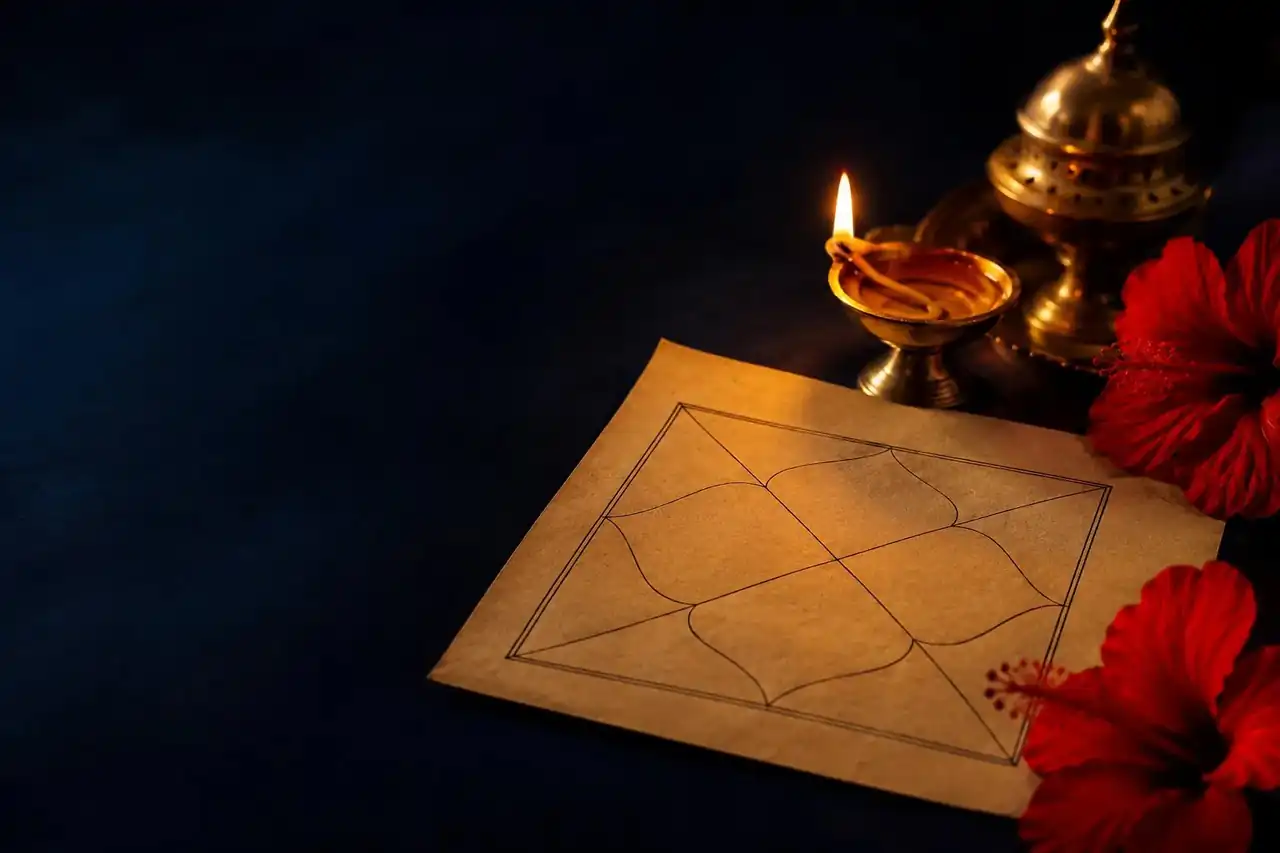
A lal kitab kundli by date of birth is drawn the same way as a Vedic chart and then read on a different rule: the house a planet sits in decides everything, the sign almost nothing. Pt. Roop Chand Joshi’s Red Book (1939–1953) treats the ascendant as house 1 and Aries, so a planet in the 7th behaves like a planet in Libra whatever sign is actually there. That is why a lal kitab kundli by date of birth from this page can call a planet buland (strong) that your Vedic chart calls debilitated — both are correct in their own book, and this page prints the Lal Kitab table beside the Vedic one so the difference is visible.
Lal Kitab Upay by Date of Birth — Which Remedy Is Actually Yours
Lal kitab upay by date of birth is the reason most people open a lal kitab kundli by date of birth, and the reason most lists are useless: a remedy belongs to a planet in a house, not to a wish. Feeding dogs is for Ketu in certain houses; floating coconut in water is for a specific Moon; keeping silver is for one placement and harmful in another. Lal kitab upay by date of birth on this page is printed per planet-in-house, with the house that made it active, so the “upay for money” you find elsewhere can be checked against the chart before you spend a day on it.
Lal Kitab Rin Dosh — the Seven Debts, Each With Its Rule
Lal kitab rin dosh is the book’s own idea: seven debts (rin) — self, mother, father (pitru), relatives, wife (stri), daughter and the unborn — each triggered by named planets in named houses, not by a feeling of bad luck. Pitru rin, for instance, is Jupiter afflicted in the 2nd, 5th, 9th or 12th with a malefic; stri rin is Venus in the 2nd or 7th with a malefic. Lal kitab rin dosh is tested rule by rule in this lal kitab kundli by date of birth, and the page says which debts your chart carries and which it does not — usually one or two, never all seven.
Sleeping Planets in Lal Kitab — Soye Grah and What Wakes Them
Sleeping planets in the Red Book are planets that sit in a house with no aspect and no companion — present but inactive, giving neither their good nor their bad until something in life “wakes” them: the birth of a child, a marriage, a house bought, an age reached. Sleeping planets in lal kitab are printed in this lal kitab kundli by date of birth with the condition that wakes each one, because a remedy for a sleeping planet is wasted and a remedy after it wakes is the one that counts.
Lal Kitab vs Vedic Kundli — Same Sky, Different Book
Lal kitab vs vedic kundli is not a question of accuracy but of method. The planets are at the same degrees; the Vedic chart reads sign, dignity, aspect and dasha; the Red Book reads house, the planet’s pakka ghar, friend-and-enemy by house, and the 35-year varshphal cycle, and it has no dasha at all. Lal kitab vs vedic kundli therefore disagree often and are meant to: this lal kitab kundli by date of birth prints both and does not pretend one is the other.
Pakka Ghar in Lal Kitab — Every Planet’s Permanent House
Pakka ghar in lal kitab is the house each planet owns by nature regardless of the chart: Sun 1, Moon 4, Mars 3 (and 8), Mercury 7, Jupiter 2 (and 5, 9, 12), Venus 7, Saturn 8 (and 10), Rahu 12, Ketu 6. A planet in its pakka ghar is read as settled and needs no upay; a planet in an enemy’s pakka ghar is the placement the remedies were written for. Pakka ghar in lal kitab is the first column of the table this lal kitab kundli by date of birth prints, because every other rule refers back to it.
Lal Kitab Varshphal 2026 — the 35-Year Cycle, This Year
Lal kitab varshphal 2026 is not a solar return. The Red Book gives each planet fixed years in a 35-year cycle starting at birth, so the ruling planet of any year is a matter of arithmetic on the age, adjusted by the birth chart. Lal kitab varshphal 2026 in this lal kitab kundli by date of birth names the year’s planet, the house it activates, and the one upay the book pairs with it — the annual reading that the yearly “rashifal” pages never derive.
Lal Kitab Upay Rules 43 Days — How the Book Says to Do It
Lal kitab upay rules 43 days are the part everyone skips: a remedy is done for 43 consecutive days (or 40, by some editions), one remedy at a time, never for two planets at once, begun on the planet’s day, without telling others, and not repeated once the result is seen. Some are permanent (a metal kept), some are one-time (an item floated), and the book forbids certain ones outright for certain charts. Lal kitab upay rules 43 days are printed with each remedy here so the upay is done the way it was written, not the way a forward said.