Dasha & Timing
Mahadasha Calculator by Date of Birth — Which Dasha Is Running, and When It Changes
Free from your birth chart — then unlock every period of your life, decoded.
Free from your birth chart — then unlock every period of your life, decoded.
The Moon's nakshatra anchors your whole timeline. Your complete birth chart with every planet is in the full report.
Instant premium PDF · secure payment · delivery guaranteed
Your Moon's nakshatra at birth names your first dasha lord — and the crossed portion sets the exact balance you were born with.
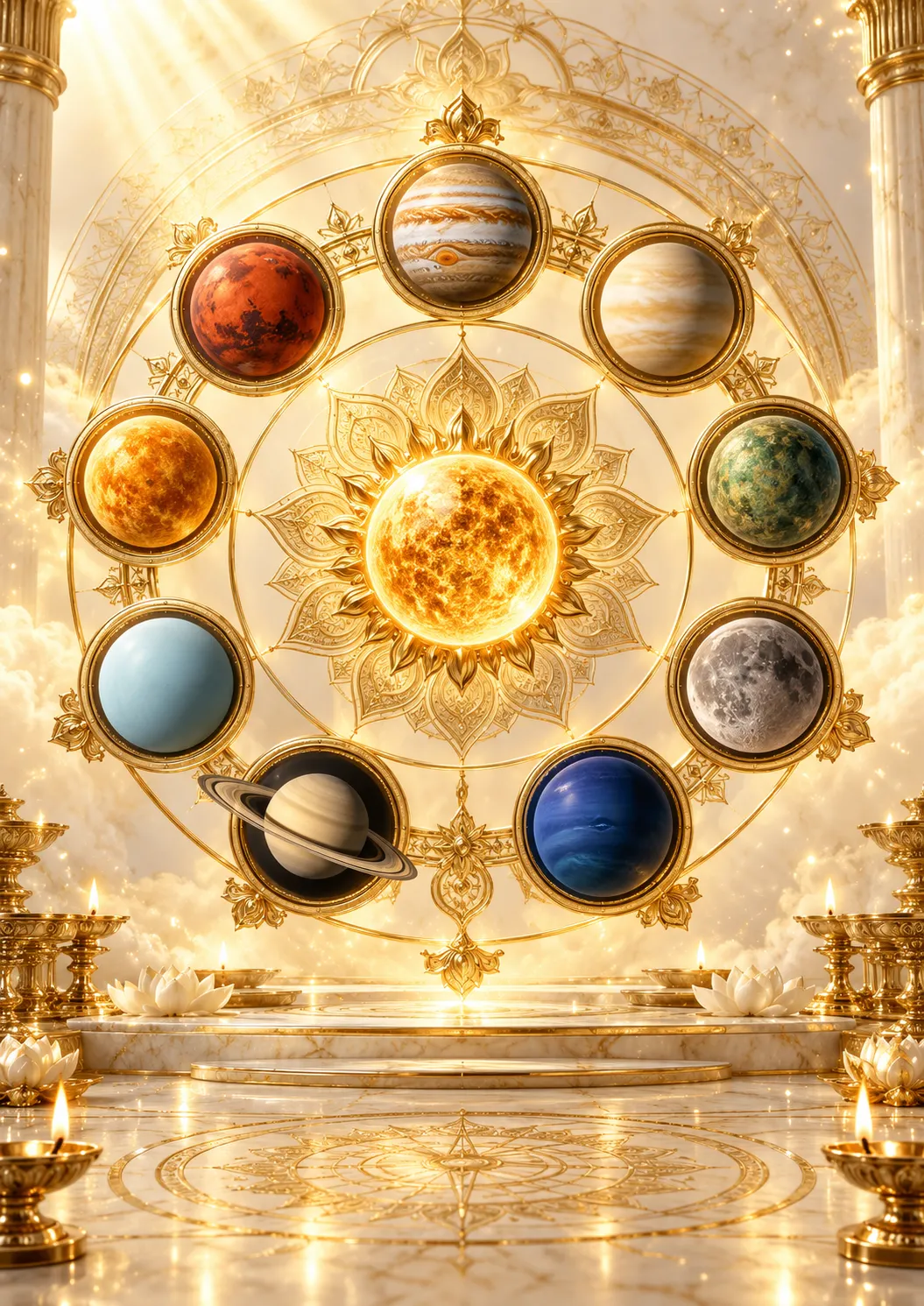
Ketu 7 · Venus 20 · Sun 6 · Moon 10 · Mars 7 · Rahu 18 · Jupiter 16 · Saturn 19 · Mercury 17 — the fixed sequence, dated to the day for YOUR birth.
Mahadasha (chapter) → Antardasha (mood) → Pratyantardasha (weeks). Your free result shows the full running stack — with every change-date.
Every date above your result is computed from your exact birth details — never rounded, never guessed.
Swiss Ephemeris + Lahiri ayanamsa. Your Moon's longitude — and therefore your whole timeline — computed exactly, including the true balance at birth most apps round away.
Not just the Mahadasha — your Antardasha and Pratyantardasha too, each with start and end dates, plus a countdown to the next change.
A period delivers its planet AS IT IS in your chart. We show the lord's dignity with every card — an exalted Saturn and an afflicted Venus read very differently, and honestly.
Dasha-sandhi — the tender crossover months — are computed and shown, so you plan completions and launches with open eyes.
Date, exact time and place — the Moon moves 13° a day, so time matters.
Swiss Ephemeris computes your nakshatra, balance at birth and every period, to the day.
Maha → Antar → Pratyantar free; unlock every period of your life, decoded.
Eight chapters, 120+ chart-computed sections — every marriage question answered. Nothing generic, nothing guessed.
| What you get | Free | Full Report |
|---|---|---|
| Your running Maha → Antar → Pratyantar stack | ✓ | ✓ |
| Supportive marriage window | ✓ | ✓ |
| Partner profile (looks, nature, profession, direction) | ✗ | ✓ |
| 9 compatibility scores + Navamsa (D9) | ✗ | ✓ |
| Children, money, remedies & lucky guide | ✗ | ✓ |
| Manglik check, Darakaraka, Saptamsa (D7) | ✗ | ✓ |
| Partner’s direction, age-gap, name-initial & family | ✗ | ✓ |
| Love vs arranged — how & where you’ll meet | ✗ | ✓ |
| Married-life dynamics, romance & in-laws | ✗ | ✓ |
| Money, property & foreign settlement after marriage | ✗ | ✓ |
| All 9 planetary positions with signs & nakshatras | ✗ | ✓ |
| Lucky gemstone, mantra, muhurat & full remedy plan | ✗ | ✓ |
| Premium 161-page PDF, yours to keep forever | ✗ | ✓ |
Your current stack, every change-date and the junction months are in the free result above — computed for your chart.
Enter your birth details above · every date from the Swiss Ephemeris




Be the first to review this reading.

Every AstroMool reading is generated from your exact birth chart using the Swiss Ephemeris and classical Parashari & Jaimini principles, then reviewed for accuracy — no generic templates, no guesswork. Last updated: September 2026
Vimshottari Dasha is the master clock of Vedic astrology — a 120-year cycle that divides your life among the nine planets. At any moment one planet runs your Mahadasha (the major period, 6–20 years), inside it another runs the Antardasha (the sub-period, months to a few years), and inside that a third runs the Pratyantardasha (weeks to months). Events tend to arrive when their significator’s period runs: career moves in the 10th lord’s time, marriage in the 7th lord’s or Venus’s time, and so on. The sequence is fixed — Ketu, Venus, Sun, Moon, Mars, Rahu, Jupiter, Saturn, Mercury — but WHERE your life begins in that wheel depends on the Moon’s nakshatra at your birth, which is why two people the same age live completely different chapters. The free calculator computes your running stack and your full lifetime timeline to the exact day.
A mahadasha calculator by date of birth reads one thing first: the Moon’s nakshatra at birth. That nakshatra’s lord rules the first mahadasha, and how far the Moon has travelled through the nakshatra decides how much of it was left at birth — the balance. Every date after that is arithmetic on the 120-year Vimshottari sequence. The two places calculators differ are the ayanamsa and the year length (365.25 versus 360 days); this mahadasha calculator by date of birth prints both choices so a second astrologer can reproduce every date.
Which mahadasha is running now is the question most people actually have, and a 120-year table from any mahadasha calculator by date of birth answers it badly. This page names the current mahadasha, the antardasha inside it, the pratyantar inside that, and the exact date each one ends — in one line at the top of the result. Which mahadasha is running now also tells you which planet’s house, sign and strength in your chart is being “switched on”, and that is the part the name alone cannot tell you.
When will my mahadasha change has an exact answer from this mahadasha calculator by date of birth — a date, printed here — and a more useful one: the six months on either side of it. The last antardasha of a mahadasha is always the next lord’s, so the new planet is already audible before the change; and the first antardasha of the new one is the same lord twice, so it lands heavily. When will my mahadasha change is best read as a window, and this page marks it.
An antardasha calculator with dates is where marriage, job change and relocation actually get timed. The mahadasha sets the theme for years; the nine antardashas inside it run from a few months to a few years each, and the events cluster at their boundaries. This mahadasha calculator by date of birth prints all nine antardashas for your current mahadasha with start and end, and the pratyantar for the current antardasha, so you can check the past against the table before trusting it for the future.
Ketu mahadasha good or bad is answered on every blog with a shrug — “spiritual, detached, difficult”. The texts are more specific: Ketu in a kendra or trikona (1, 4, 5, 7, 9, 10) from the lagna, or in the 3rd or 11th, gives a period of sharp gains and clarity; Ketu in the 6th, 8th or 12th, or with the Moon, gives the difficult version everyone fears. Ketu mahadasha good or bad is therefore a question about your chart, not about Ketu, and this page prints where yours sits before it says anything else.
Which mahadasha is best for marriage is not “Venus” or “Jupiter” as a rule. The classical trigger is the dasha or antardasha of the 7th lord, of a planet in the 7th, of Venus (for men) or Jupiter (for women) as karaka, or of the Navamsa lagna lord — whichever comes first at a marriageable age. Which mahadasha is best for marriage in your chart is therefore a short list of two or three periods with dates, and this page prints them.
Dasha sandhi meaning — the one thing a mahadasha calculator by date of birth should mark and rarely does — is simple: the junction where one mahadasha ends and the next begins, and the months on either side of it. The texts treat it as unstable because two planets with opposite natures — Mars into Rahu, Jupiter into Saturn, Mercury into Ketu — are handing over. Dasha sandhi meaning matters in practice because the sandhi is where health, job and relationship shifts cluster, and it is the one thing a plain 120-year table hides. This page marks every sandhi in your timeline.
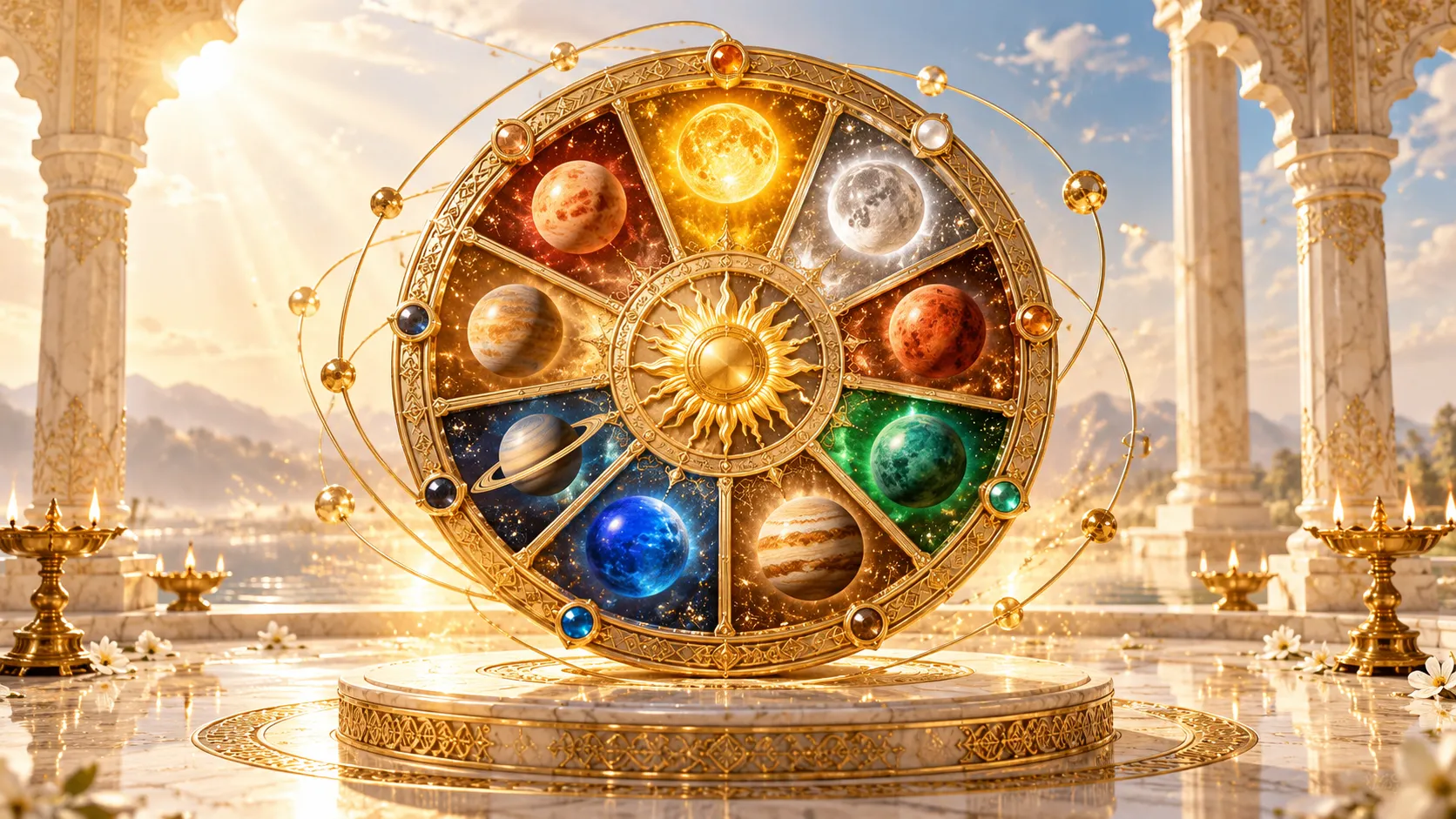
Your starting point in the Vimshottari cycle comes from the Moon’s nakshatra at birth. Each of the 27 nakshatras belongs to one of the nine planets; the portion of the nakshatra the Moon had already crossed decides how much of that first Mahadasha was “used up” before you were born — the balance is what you actually live. From there the fixed sequence unrolls: Ketu 7, Venus 20, Sun 6, Moon 10, Mars 7, Rahu 18, Jupiter 16, Saturn 19 and Mercury 17 years. This is why the birth time matters: a few minutes can shift the Moon enough to change your whole life’s calendar.

Think of the Mahadasha as the hour hand — it sets the chapter and its themes. The Antardasha is the minute hand: within a Jupiter chapter, a Venus sub-period feels different from a Saturn one. The Pratyantardasha is the second hand — weeks-long windows that time the actual events. Classical practice reads all three together: an event is most likely when the same significator, or friendly ones, hold two or three hands at once. That triple stack, dated, is exactly what the free result shows.

A Saturn Mahadasha is not “bad” and a Venus one is not automatically “good” — each period delivers the planet AS IT IS IN YOUR CHART. An exalted Saturn ruling good houses builds careers for 19 steady years; an afflicted Venus can make its 20 sweet-sounding years demanding. The lord’s dignity, the houses it rules, and its placement decide the flavour. That is why honest dasha reading always starts from your chart, never from the planet’s name alone.
The crossover from one Mahadasha to the next — the dasha-sandhi — is traditionally treated as tender: the outgoing planet is settling accounts while the incoming one has not yet taken charge. Classical advice is simple: complete, consolidate, avoid launching the biggest moves right at the junction, and let the new period establish itself for a few months. Knowing your junction dates in advance — they are computed, not guessed — turns a confusing patch into a planned one.
A dasha never forces an event; it opens and closes windows. The chart marks WHEN a theme is supported — effort, choices and circumstances still decide WHAT happens. Anyone reading a dasha as a fixed sentence, good or bad, is misusing the tool. Read it the working way: know your current stack, note the next change-date, push the right themes in supportive sub-periods, and use demanding ones for the quiet work they reward.
The exact date is printed at the top of your free result. Treat the six months either side of it as the change window - the last antardasha of the old period already belongs to the next lord, and the first antardasha of the new one is that lord twice over.
Enter your birth details and the result names your current mahadasha, antardasha and pratyantar with their end dates. The birth time matters: the Moon moves about a degree an hour, and at a nakshatra boundary an hour can shift the balance by months.
Saturn runs 19 years. Your exact end date is in the timeline above. Whether those years are heavy depends on where Saturn sits from your lagna - Saturn in the 3rd, 6th, 10th or 11th, or as yogakaraka for Taurus and Libra lagnas, gives a strong period, not a punishing one.
Rahu mahadasha effects depend on Rahu's house and the planets it sits with - not on Rahu alone. In the 3rd, 6th, 10th or 11th it gives sudden rise; in the 8th or 12th, or with the Moon, it gives the confusion and losses people fear. The result above prints Rahu's house and the antardashas inside the period so you can see which years carry which.
Three settings: the ayanamsa (Lahiri here), the year length (365.25 days here), and whether the birth time was rounded. A few days' difference is normal; a difference of months usually means a different ayanamsa or a nakshatra boundary at birth.
Approximately. The Moon changes nakshatra roughly every 24 hours, so the mahadasha lord is usually right without a time, but the balance at birth - and therefore every date - can be off by up to the full length of a mahadasha. Enter the closest time you have and the result flags whether you are near a boundary.
Enter your birth date, time and place — the calculator computes your Moon’s nakshatra and shows your running Mahadasha, Antardasha and Pratyantardasha with exact dates, free.
From the Moon’s longitude at birth: its nakshatra names the first lord, the crossed portion sets the balance, and the fixed 120-year sequence (Ketu 7, Venus 20, Sun 6, Moon 10, Mars 7, Rahu 18, Jupiter 16, Saturn 19, Mercury 17) unrolls from there.
The Mahadasha is the major chapter (6–20 years); the Antardasha is the sub-period inside it (months to a few years) that colours how the chapter behaves right now. The Pratyantardasha is the still finer layer that times actual events.
Periods of the planets that RULE those areas in your chart — the 10th lord for career, the 7th lord and Venus for marriage. It depends on your chart, not on the planet’s name; the calculator shows your lords and the report grades every period.
No. Saturn delivers itself as it stands in YOUR chart — a strong Saturn gives 19 years of steady building. The dignity shown in your result is the honest first clue.
The junction months where one Mahadasha ends and the next begins — traditionally a tender crossover, better used for completing than launching. Your junction dates are computed exactly.
We compute with the Swiss Ephemeris and the Lahiri ayanamsa to the day, including the true balance at birth. Apps that round the Moon’s position or ignore the balance drift by months.
Yes — the Moon moves about 13° a day, so hours matter. A wrong time can shift your whole timeline; even the balance of the first dasha depends on it.
It marks supported windows, never fixed events. Honest reading: know the stack, note the change-dates, act with the themes — the report grades every window for your chart.
Yes — your full running stack, the lifetime Mahadasha timeline and the next change-dates are completely free, computed from your exact birth details.
Page generated: 20 Sep 2026, 18:43 IST · build cp-2609201843