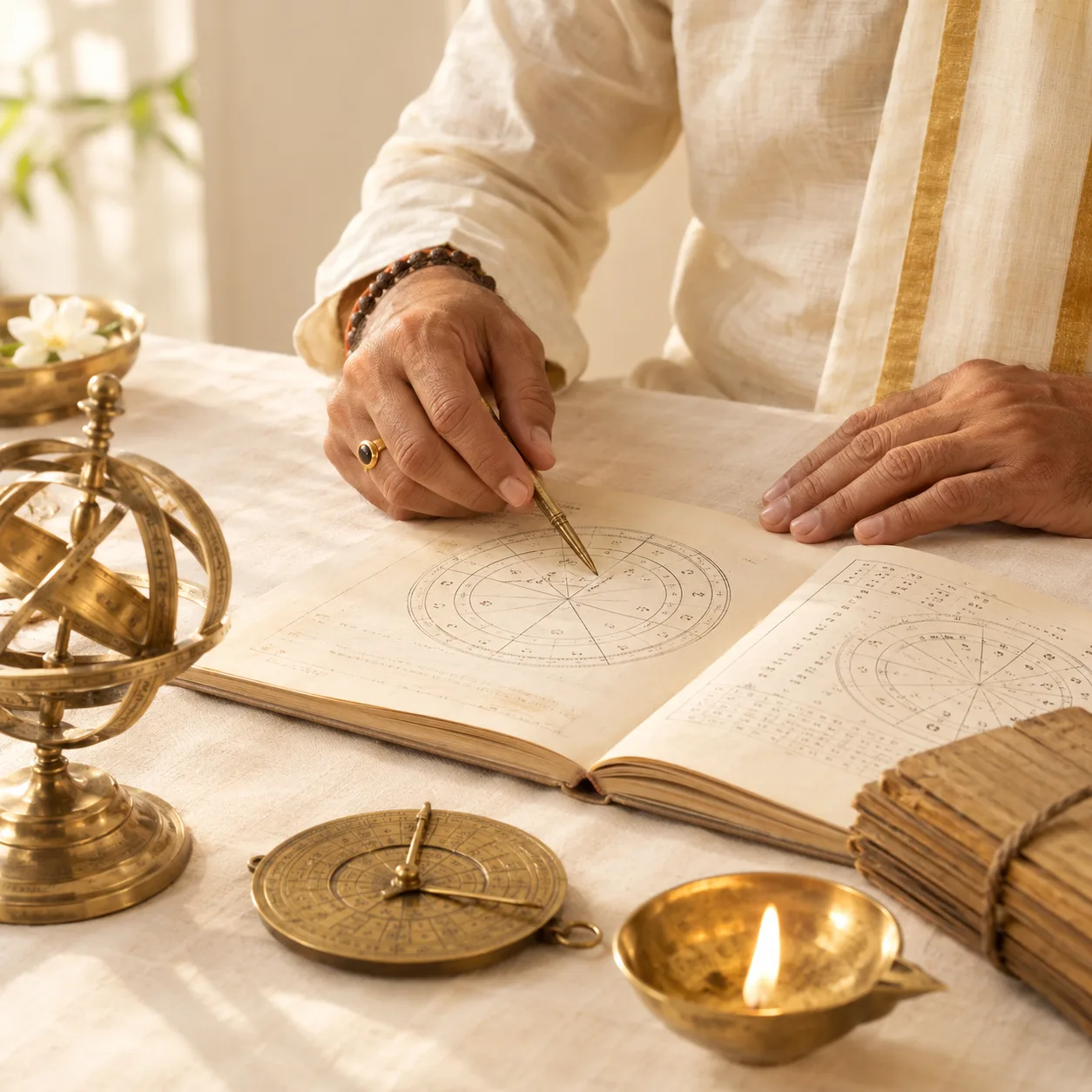
Your rising sign with its exact degree, the lagna lord and its house, and the lagna nakshatra. Plus the thing no other calculator tells you - how many minutes your birth time can be wrong before the sign itself changes.
Guna Milan reads both Sun charts — the birth-star, the sign and the quarter within it produce the eight tests and your total out of 36. Your own scores are in the free result above; the rule behind each one, and what it means day to day, is in the full report.
Instant premium PDF · secure payment · delivery guaranteed
Both Sun charts are read and each of the eight tests gets its own score out of 36 — with the rule that produced it printed beside it.
Manglik, Nadi and Bhakoot are checked for both of you — and every classical exception is computed on your own charts, never assumed.
Where a score came out low, you get the fix: what to do, what to avoid, and the dates when your chart support a wedding.
Your own scores are free, above. The rule behind each one, the exceptions, and the dated windows are in the full report.
The lagna - ascendant, rising sign, udaya lagna - is the zodiac sign rising on the eastern horizon at the exact moment and place you were born.
It sounds like one detail among many. It is not. The lagna decides which sign sits on your first house, and every other house is counted from there. Change the lagna and all twelve houses shift with it - your 7th house, your 10th house, your 5th, all of them. Every finding that depends on a house depends first on this.
The whole zodiac rises past the eastern horizon in twenty-four hours. Twelve signs in twenty-four hours works out to roughly two hours per sign - and one degree of lagna in about four minutes.
Compare that with everything else in your chart. The Sun takes a month to change sign. The Moon takes two and a quarter days. Saturn takes two and a half years. The lagna changes every two hours. It is, by a wide margin, the most birth-time-sensitive figure in Vedic astrology.
Which is why a birth time wrong by an hour can move you into a different lagna entirely, and everything read from the houses moves with it. A chart built on a guessed time is a chart that may be reading the wrong twelve houses.
"Two hours per sign" is an average, and the variation is larger than most people realise.
The zodiac is tilted against the celestial equator by about twenty-three and a half degrees, so from any given latitude some signs cross the horizon steeply and others at a shallow angle. The steep ones rise quickly; the shallow ones take much longer.
At Indian latitudes - roughly 8° to 35° north - the difference is real. Some signs rise in around ninety minutes; others take close to two and a half hours. The classical texts even name them: the quickly-rising signs are called sheershodaya (rising head-first), the slowly-rising ones prishthodaya (rising back-first).
The practical consequence: how much your birth time matters depends on which lagna you have. Someone with a fast-rising sign has a narrower window; someone with a slow-rising one has more room. This page recomputes your lagna at several nearby birth times so you can see which case you are in, instead of being handed a generic warning about accuracy.
Your lagna lord is the planet that rules your rising sign. If your lagna is Aries, Mars is your lagna lord; if it is Cancer, the Moon; if Libra, Venus.
Where that planet sits is among the most heavily used single facts in classical reading. A lagna lord well placed - in a kendra, in its own sign, exalted - is read as the chart being carried along. A lagna lord in a difficult house or condition is read as effort required. That one placement gets consulted more often than almost any other rule in the system.
We print it with its house, its sign and its dignity, because a lagna without its lord is half the picture.
Your rising degree also falls in a nakshatra and a pada. Most ascendant calculators give a sign and stop, but the lagna nakshatra is used in several classical contexts and it is a far more specific piece of information than the sign alone.
It also tells you something the sign cannot: if your rising degree sits near a nakshatra boundary, your lagna is sitting near an edge in more than one sense.
Here it is worth being careful, because the popular description and the classical one are not identical.
The lagna is widely described as "your outward personality" while the Moon sign is "your inner nature". That is a modern gloss - a reasonable one, and useful as a shorthand, but not what the texts say.
The classical first house covers the body, the physical self, general constitution, and how a life begins and proceeds. It is read for vitality and for the person as a whole entity rather than for a personality type. Close enough to the popular version to be useful; not the same claim, and we would rather tell you which is which.
A great many people do not - in India most birth times come from family memory rather than a hospital record, and memory rounds to the nearest hour or the nearest meal.
Most free calculators handle this by quietly using noon and presenting the result as your chart. We do not. This page will show you which lagna each likely time gives, so you can see whether the answer holds across your uncertainty or changes partway through it.
That is a more honest position, and a more useful one. If your lagna is the same across a four-hour window, you can rely on it. If it changes twice in that window, you now know that any house-based reading of your chart is provisional - which is worth knowing before anyone reads you a 7th house.
Where to look for a real time: a hospital discharge slip, a birth certificate, an immunisation card, an old horoscope written at the time. Any of them usually carries it, and any of them settles this permanently.
Two reasons, in order of likelihood.
The ayanamsha. Vedic astrology uses the sidereal zodiac; western astrology uses the tropical. The gap is currently about twenty-four degrees, so a tropical ascendant will usually be one sign ahead of your sidereal one. That is not a disagreement about your birth - it is two different zodiacs. We use Lahiri, the Indian standard.
The coordinates. The ascendant depends on both longitude and latitude, and a hundred kilometres moves it by several minutes of arc. A nearest-city lookup is not the same as your actual birthplace.
If your lagna is near a sign boundary, either of these can flip it - which is another reason we print the degree rather than only the name.
The classical writers use all three and do not rank them. A chart is read from the ascendant, from the Moon, and often from a relevant karaka as well - and a finding that holds from all three references is considerably stronger than one holding from a single one.
That is the most useful thing to take away. Anyone reading your chart from the lagna alone, or from the Moon alone, is using a third of the method - and this page gives you all three so you can see when they agree.

The exact ascendant degree, which nakshatra and pada it falls in, and a flag if the degree sits near a sign or nakshatra boundary where small errors matter.
Your ascendant recomputed at several nearby birth times with the sign at each - the most useful thing on this page if your time came from family memory rather than a record.
The zodiac tilted against the horizon, sheershodaya and prishthodaya signs, and why ninety minutes and two and a half hours are both real answers to "how long does a sign take to rise".
Which planet rules your rising sign, its house, sign and dignity - and why this single placement gets consulted more than almost any other rule in classical reading.
The body, the physical self, vitality and how a life proceeds - set against the modern shorthand of "outward personality", which is useful but not the same claim.
Why the classical writers count from all three, and why a finding holding across all of them is stronger than one resting on a single reference.
The ayanamsha first, the coordinates second, and how to tell in ten seconds which one explains the difference you are seeing.
Swiss Ephemeris + Lahiri ayanamsa — the same standard as traditional panchangs. Both Suns computed from real birth details and real coordinates, never guessed from a name.
Every score prints the classical rule that produced it, right beside the number. Any astrologer can check our working line by line.
A dosha is a signal to check, never a verdict on two people. We compute the classical exceptions on your own charts and state every remedy with its honest limit.
The Hindi report is written natively — not machine-translated. English and Hindi carry the same 111 page depth, chapter for chapter.
Date, time and place — the Sun sign is the anchor, and time makes it certain.
Swiss Ephemeris (Lahiri sidereal) tracks the Sun through the 12th, 1st and 2nd signs from your Sun — day-level, your chart checked together.
See your score, timeline and end date free; unlock the verdict, life-area guidance and remedies.
🔒Both Charts
🔒Eight Tests
🔒Dosha Checks
🔒Verdict & Plan
🔒RemediesFull-page part plates, 11 computed tables — unlocked instantly.
Everything below is computed from your birth details and shown on screen. There is no paid version of this tool.
Every date computed from your own chart — nothing generic, nothing guessed.
| What you get | Free | Full Report |
|---|---|---|
| Your lagna, named | ✓ | ✓ |
| The exact rising degree | ✓ | ✓ |
| The lagna lord and its house | ✓ | ✓ |
| The lagna lord's dignity | ✓ | ✓ |
| Lagna nakshatra and pada | ✓ | ✓ |
| Birth-time sensitivity test | ✓ | ✓ |
| Fast or slow riser at your latitude | ✓ | ✓ |
| Your full chart, drawn | ✓ | ✓ |
| Moon sign and Sun sign alongside | ✓ | ✓ |
| Nothing held back for a paid version | ✓ | ✓ |
Instant PDF · from ₹99 · the same engine you just used free
This lagna calculator by date of birth answers the six questions people search most — how to find my lagna, ascendant calculator vedic free, lagna and lagna lord calculator, what is my rising sign vedic, lagna kaise pata kare — each with the rule behind it. The lagna calculator by date of birth above computes your own result free; the sections below explain what it means, and a lagna calculator by date of birth that shows its working is one you can check against any astrologer.
A lagna calculator by date of birth needs the time and the place, because the ascendant is the sign rising in the east at the moment of birth and it changes roughly every two hours. Two people born the same day in different cities can have different lagnas; two born an hour apart in the same city often do. This lagna calculator by date of birth uses the Swiss Ephemeris and the Lahiri ayanamsa, prints the ascendant degree, and warns you when the birth time sits within a few minutes of a sign boundary, because then the whole chart rotates on that one minute.
How to find my lagna comes down to three inputs: the date, the exact time and the place of birth. The date gives the Sun's position, the time gives how far the sky has turned, and the place gives the horizon. Without the time, the lagna cannot be found — only the Moon sign can. How to find my lagna without a time is a question this page answers honestly: it cannot, and it shows you the two or three lagnas the day allows so you can rectify from life events.
An ascendant calculator vedic free of Western assumptions uses the sidereal zodiac, which sits about 24 degrees behind the tropical one. That is why a Western site may call you a Leo rising and a Vedic one a Cancer rising — both are computing the same sky with different zero points. This ascendant calculator vedic free tool uses Lahiri, the ayanamsa used by the Indian government's ephemeris and most classical practitioners, and prints the ayanamsa value so the result can be checked.
A lagna and lagna lord calculator does what a sign-only tool skips: it finds the planet ruling the ascendant sign and reads where it sits. A Leo lagna with the Sun in the 10th is a very different life from a Leo lagna with the Sun in the 12th. This lagna and lagna lord calculator prints the lord's house, sign, dignity and nakshatra, because the texts read the lagna lord as the native's own strength — the first thing to check before any yoga or dosha.
What is my rising sign vedic astrology answers with twelve temperaments: Aries acts first, Taurus holds, Gemini talks, Cancer protects, Leo leads, Virgo fixes, Libra balances, Scorpio keeps, Sagittarius believes, Capricorn climbs, Aquarius reforms, Pisces feels. The lagna is the body and the manner; the Moon is the mind. What is my rising sign vedic astrology also sets the house numbering for everything else, which is why the lagna is computed before the dasha, the yogas or any remedy.
Lagna kaise pata kare is the most searched form of this question, and the answer is: enter the birth time and city above and the ascendant is computed in a second, with the degree. Lagna kaise pata kare without a birth certificate is harder — use the hospital record, a family diary, or the two-hour window the family remembers, and this page will show which lagnas fall in it. Nothing here needs a visit; the working is printed so any astrologer can check it.
If you came to this lagna calculator by date of birth to check a result from another app, compare the degree, not just the sign — two tools using different ayanamsas will disagree by about a sign near boundaries. This lagna calculator by date of birth prints Lahiri, the value used, and every intermediate step, so the lagna calculator by date of birth result can be verified line by line.
Be the first to review this reading.
Page generated: 23 Sep 2026, 11:07 IST · build cp-2609231107